
A year working with the Alpine Club's forgotten negatives has brought four remarkable climber-photographers back into the light. Angus Dodd of Salto Ulbeek tells the story (with plenty of help from Adam Butterworth of the Alpine Club).
In November 2025 we were invited into the Alpine Club archive. It is a windowless basement in Shoreditch, East London - and an Aladdin's Cave of mountaineering history. There are paintings, boxes of rocks, dozens of ice axes, old boots and ancient oxygen equipment. In amongst it all was a treasure trove of glass and celluloid negatives. They seemed to have been overlooked for years. Most were poorly catalogued, or not catalogued at all.
The first thing that struck us was the quality of the images. There were vast mountainscapes, sadly with more snow and ice than today. There were finely detailed portraits and dramatic action shots. All were taken by some of the most talented climbers and mountain photographers of the late 19th and early 20th centuries.
The past 12 months have taken us back to the days of tweed jackets, hemp ropes and heavy, clumsy cameras. Working with the Alpine Club, we first scanned the negatives to preserve them, because glass plates and celluloid of course deteriorate over time. We then identified each photographer and each image. Finally, we printed a selection in platinum-palladium, for exhibition and sale.
What has emerged is a confluence of three things: the first is the quality of the original photographs, taken long before the smartphone, in cold, difficult and often dangerous places. The second is the skill of my colleagues Georges and Joost in the Ulbeek studio, who have restituted and printed them. The third is the stories behind the climbers, their climbs and the mountains they captured.
William Abney: the Pioneers of the Alps
The earliest images are portraits of mountain guides. William Abney took them on a photographic tour in 1886 with his collaborator, C. D. Cunningham. The two men were writing a book, “The Pioneers of the Alps”. It profiled the great guides of alpinism's golden age: the men involved in the first ascents of all the major Alpine peaks.
Among them is Ulrich Lauener. With fellow guide Peter Bohren, he fired the starting gun on that golden age when they led their client, Alfred Wills, up the Wetterhorn in Switzerland. Bohren had apparently climbed the peak already, but the guides assured Wills that his was the first ascent.
Another sitter is Ulrich Kaufmann. In 1883 Kaufmann joined William Woodman Graham in the Himalaya, where they made the first ascent of Kabru. At 7,400 metres, it was the highest mountain anyone had then climbed.
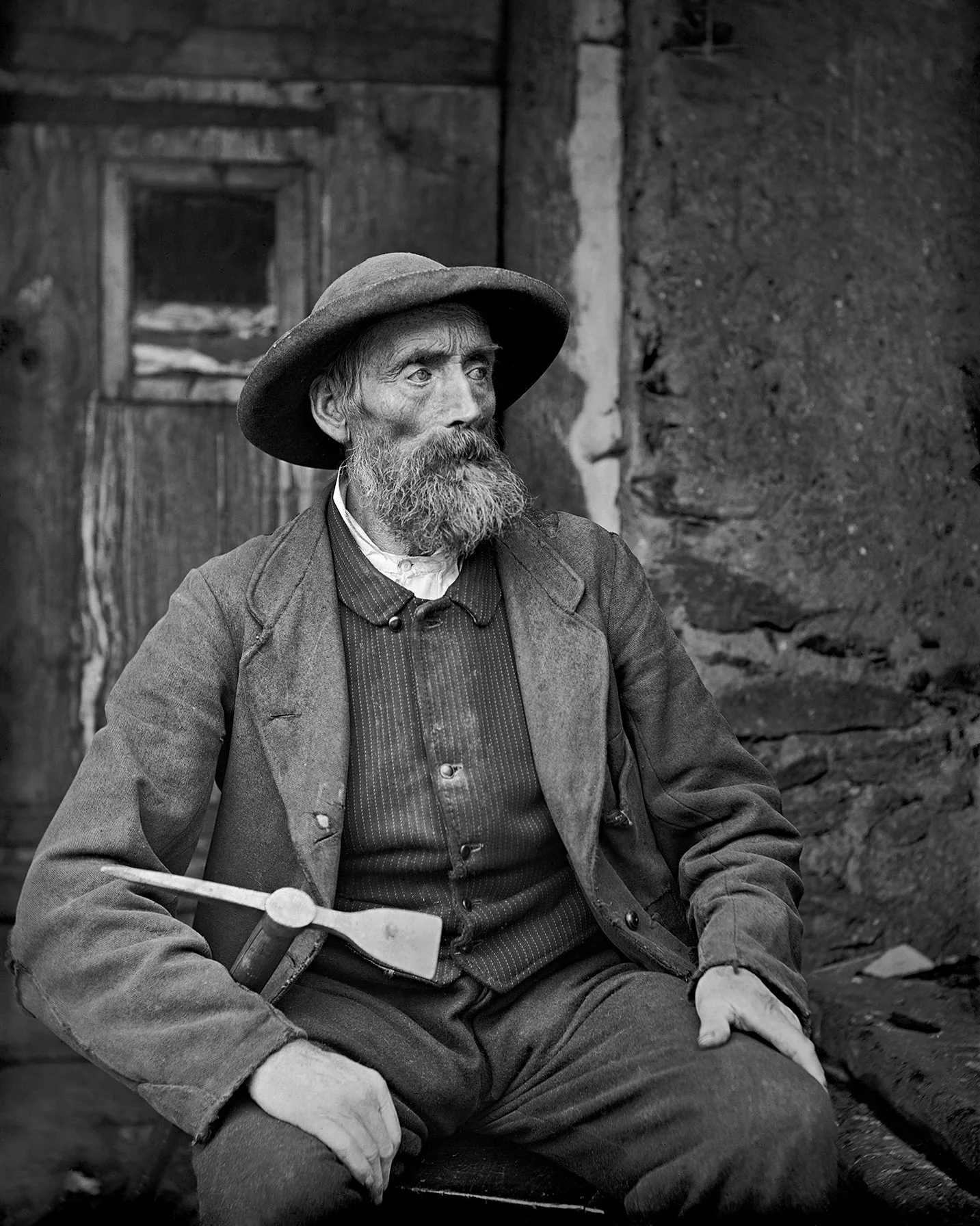
Ulrich Lauener
Abney grew up around photography. His father was a photographer and a close friend of Richard Keene, a Derbyshire photographer of some local fame. Keene belonged to the splendidly named “Brotherhood of the Linked Ring”, an early society that argued photography had artistic as well as scientific value. Few who see these prints today would disagree.
Abney believed the guides should be photographed outdoors, in natural light, in the setting where their clients would know them. He kept the project quiet, so they would turn up in their working clothes rather than their Sunday best. He was not wholly successful. Some very smart suits appear alongside some very worn ones. A favourite of ours is François Couttet. He looks more like a bank manager than a mountain guide, and went by the wonderful nickname "Baguette".
Abney also refused to retouch his images. He knew we should see these men as they were, with their wrinkles and weather lines intact. Those lines were as much a mark of their profession as the ice axes in their hands.
Sydney Spencer: mountainscape masterpieces
By his own admission Sydney Spencer achieved nothing remarkable as a climber, though he had a handful of first ascents to his name, including the first winter ascent of the Dom in Switzerland. But perhaps more than any of the others, he has a claim to be a driving force in mountain photography. For decades he organised the Alpine Club's annual photographic exhibition.
He was clearly a generous and kind man. One reader wrote to the Alpine Journal to complain that the exhibitions had too many photographs. The reason, apparently, was that Spencer hated making enemies, so he never told anyone their work was not good enough.
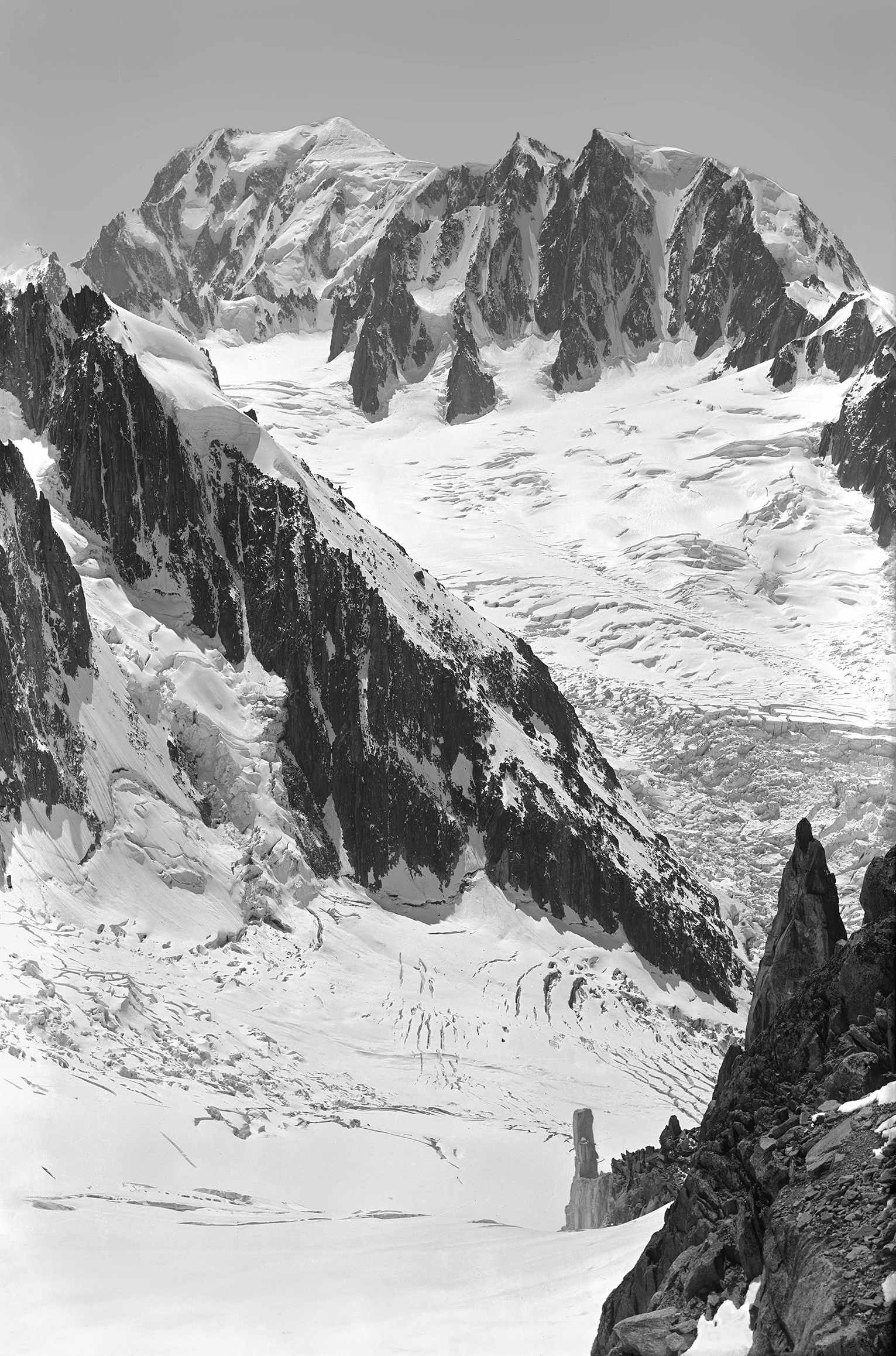
Mont Blanc from Aiguille de Tacul
His own photographs were magnificent. He was seen as the heir to the great pioneers of mountain photography, Vittorio Sella and William Donkin, and we think the reputation is richly deserved. When Geoffrey Winthrop Young edited “Mountain Craft”, one of the founding texts of mountaineering technique, he asked Spencer to write the chapter on photography. It shows just how hard photography was for these early figures. Today, my camera weighs a few hundred grams. It is also my map, my guidebook and my way of calling for rescue. Spencer advised that six plates should be enough for most climbs. Imagine having only six chances to get the shot, and coming home with work of this quality.
George Finch: the maverick mountaineer
For many of us involved in the project, George Finch is the most engaging character of all. He grew up in Australia, and the mountaineering establishment viewed him with some suspicion. That was partly, perhaps, because he came from "the colonies". But he was also strong-willed and unbending, and he could rub people up the wrong way. He was turned down for the 1921 Everest expedition after failing the medical. There is some doubt about whether he really failed it, or was kept off the team by politics.
When he went to Everest in 1922, he took his own photographs. Never short of confidence, he decided once they were developed that they were rather better than those of the official photographer, John Noel.
Finch was a scientist, unafraid of new technology. He championed bottled oxygen, and used it to climb very high on the mountain. He also took to Everest a down jacket of his own design. The makers of today's outdoor clothing ranges owe him a debt.
Of all the photographs here, Finch's feel the most modern. They are the kind of action shots climbers still take today: a figure moving away from the camera with the rope snaking behind, or a climber posing on a razor-sharp ridge in front of a staggering view. They look like the mountain adventures we all recognise.
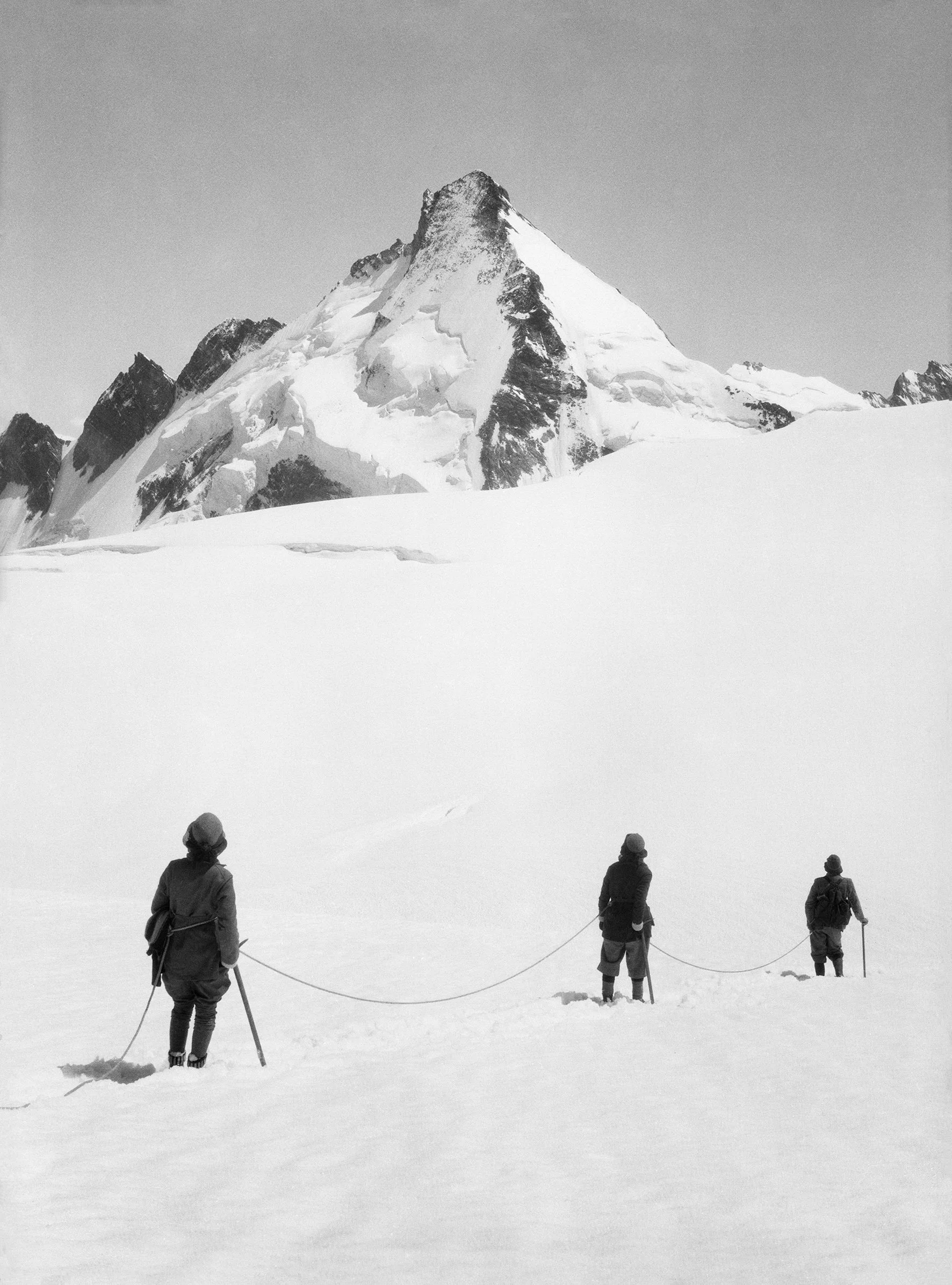
Dent d’Herens, August 1923
Frank Smythe: the first professional
Frank Smythe was, in many ways, the first professional mountaineer. Like Finch, he faced suspicion from those who thought it ungentlemanly to make a living from climbing.
He first came to public attention with two routes on the Brenva Face of Mont Blanc: the Sentinelle Rouge and the Route Major. He went on to publish numerous books about his climbs. He was also a special correspondent for The Times on the 1930 Kangchenjunga expedition. The expedition was unsuccessful, but his columns ran to more than 40 feet by the end, and they made his name.
From then on he was on something of a treadmill. He would go on an expedition, then come home and write a book about it at once, illustrated with his own photographs. He published 27 books in 20 years, covering the Alps, the Dolomites and the Himalaya.
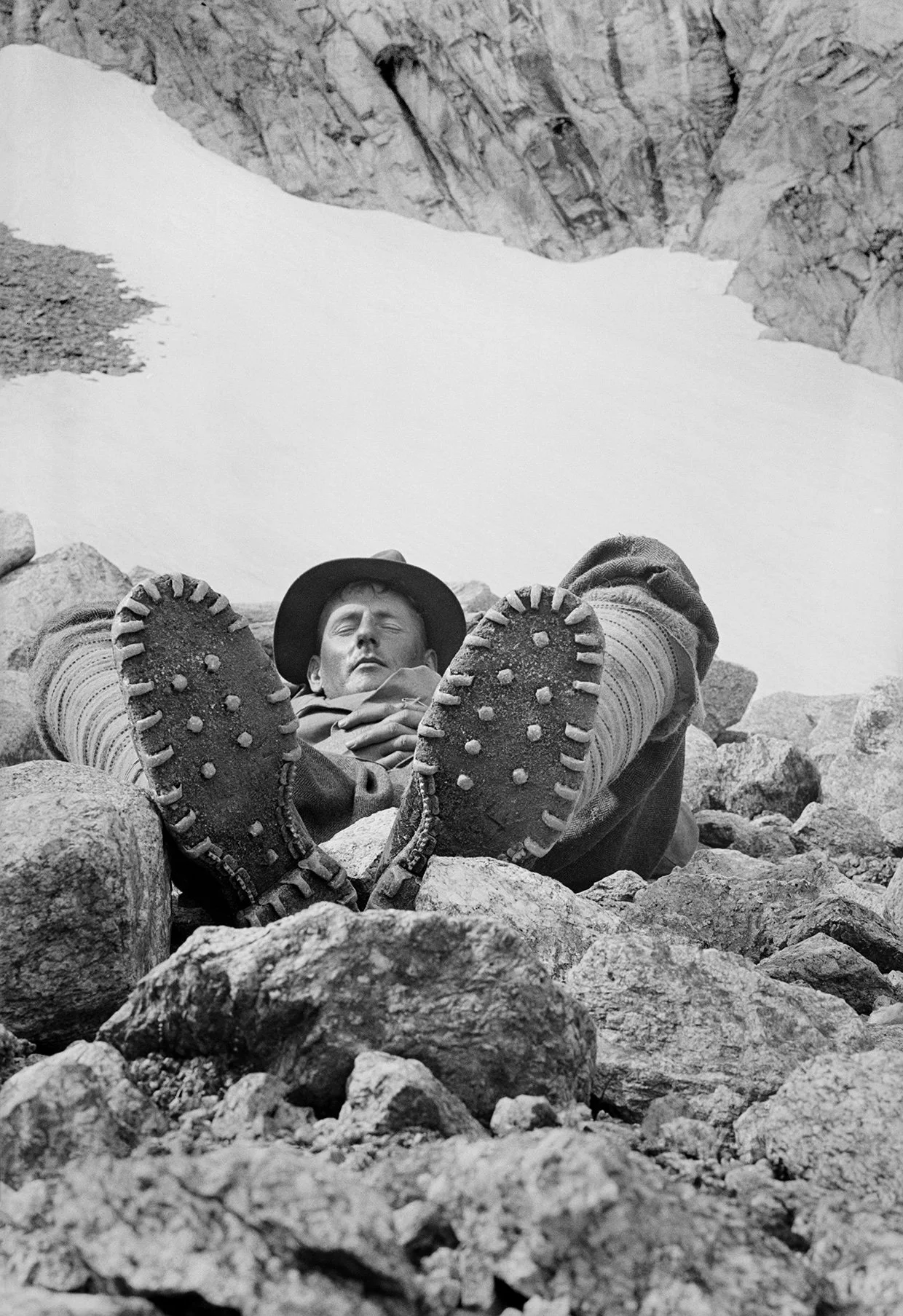
Frank Smythe self-portrait - “Rest”
Smythe fell ill with malaria in India in 1949 and died soon afterwards, aged just 48. His last book of photographs was published after his death. He had been so prolific as a climber, writer and photographer that he left an unmatched record of British climbing between the wars. He also set the template for how climbers tell their stories. Before him, the public knew mountaineering through ponderous expedition reports. Smythe made it personal and modern, and invited the outside world in.
Back to life
Each of these photographs, and each of these photographers, has more of a story than one article can hold. But in a small way, we feel we have got to know William Abney, Sydney Spencer, George Finch and Frank Smythe. The project has almost brought them back to life. Without it, their negatives would have stayed in that Shoreditch basement, unseen, until they decayed beyond repair.
In all, we scanned more than 200 images at the Alpine Club. Twenty-three are on the walls at Messums, and about 40 including the prints in our folios. We are still working through the rest, and hope to share them in 2027.
We could not have undertaken the project without the commitment and assistance of the Alpine Club, most especially Philip Meredith, Adam Butterworth, Peter Foster, Emma McDonald, Ewa Orzechowska, Simon Richardson, Bernie Ingrams and Duncan Sperry.
